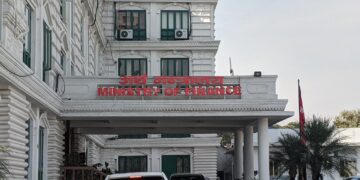
Newly appointed Finance Minister Dr Swarnim Wagle has initiated a significant push for structural economic reform by moving to repeal 15 outdated laws and abolish the Department of Revenue Investigation (DRI). The decision follows recommendations from the High-Level Economic Reform Advisory Commission, 2081 and was announced on Friday.

The move responds to long-standing demands from the private sector for a more investment-friendly and efficient legal framework. The laws identified for repeal or amendment include several decades-old acts such as the Income Ticket Duty Act, Black Market and Certain Social Crimes and Punishment Act, Private Forest Nationalization Act, and the Revenue Leak (Investigation and Control) Act, among others.
Minister Wagle said the reforms are aimed at removing administrative bottlenecks, accelerating development projects, and creating a more conducive environment for private investment. He emphasized that eliminating outdated procedures would allow major projects to move forward more quickly and reduce delays that have historically discouraged investors.
In addition to scrapping obsolete laws, the Finance Ministry plans to release an Economic White Paper within five days. This will be accompanied by 100-day, half-yearly, and annual action plans aligned with the government’s election commitments. Key priorities include facilitating private sector growth, improving procedural efficiency, and strengthening the overall economic structure.
With over 25 years of international development experience, Wagle brings a global perspective to Nepal’s economic management. He has previously served as Chief Economic Adviser at the United Nations Development Programme Asia-Pacific Regional Bureau, and held senior roles at the World Bank and UNDP offices in New York, Hanoi, and Colombo. He also served as Vice-Chair of Nepal’s National Planning Commission, where he helped coordinate development strategies and post-earthquake reconstruction efforts that secured $400 million in aid.
Born in 1974 in Gorkha, Wagle holds a PhD in Economics from the Australian National University, a master’s degree from Harvard University, and a bachelor’s degree from the London School of Economics. He entered politics in 2022, joining the Rastriya Swatantra Party, and was elected to the House of Representatives from Tanahun-1.
Wagle has consistently advocated for good governance as a foundation for sustainable economic growth, promoting digitalization, clean energy, green industrialization, tourism, and agriculture as key sectors. He has also stressed the need to streamline governance structures and modernize public administration through paperless and cashless systems.
The Finance Ministry described the targeted laws as outdated regulations that no longer align with a modern open-market economy, noting that they have created unnecessary bureaucratic hurdles and hindered investment. Analysts view Wagle’s initiative as a major step toward systemic reform, with the potential to improve governance, boost domestic production, create jobs, and reshape Nepal’s economic trajectory.