
Nepal Electricity Authority’s subsidiary, Raghu Ganga Hydropower, is constructing the 40 MW Rahughat Hydropower Project, but the nearly completed dam now faces a serious landslide threat.

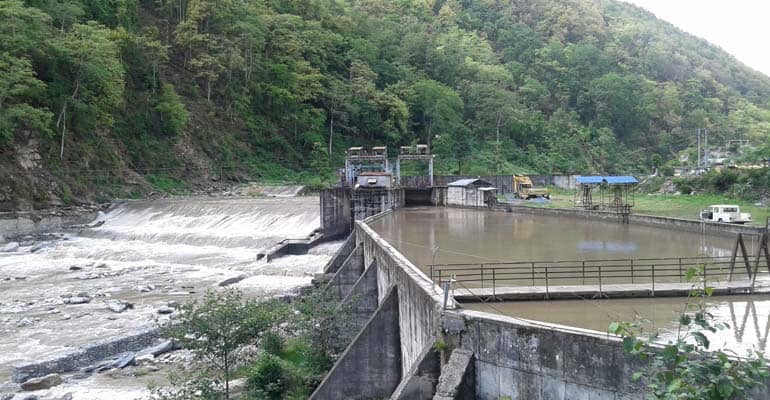
Designed to divert water from the Rahughat River into a tunnel, the dam is located near Dagnam in Raghu Ganga Rural Municipality-4 and Jhi in Ward-5, where a newly formed landslide above Dagnam village poses significant risks. Last monsoon, debris from the same landslide damaged the under-construction dam, increasing the danger for both the dam and the nearby village.
Project Chief Raj Bahadur Bista stated that the team has begun assessing the potential damage and exploring preventive measures. “We are waiting for the technical team’s study report and recommendations,” he said.
The project includes a 17-meter-high and 31-meter-long semi-reservoir (PROR) technology-based dam, along with a desander (settling pond) on the right bank of the Rahughat River. However, a landslide has formed approximately 300 meters above the dam, desander, and tunnel inlet.
Despite these challenges, the project has achieved 82% physical progress. Civil contractor Jayaprakash Associates has nearly completed the dam, tunnel, and powerhouse construction. Rabin Kattel, head of the project’s civil division, stated that the team is accelerating efforts to meet the completion target by mid-June 2025.
The completed structures include the dam’s barrage, a 6,270-meter-long main tunnel, surge shaft, vertical and third pressure shafts, and tailrace duct. Ongoing work includes finishing the desander, power intake, main tunnel lining, and penstock pipeline installation. Meanwhile, the powerhouse in Tilkenichaur, Raghu Ganga-3, is 90% complete, with Bharat Heavy Electricals Limited (BHEL) installing turbines and generator equipment.
Additionally, the team has begun constructing the Air Insulated Switchyard (AIS) at the powerhouse complex, which will receive energy from the generator and transfer it to the transmission line. The completed 128-meter-long tailrace will direct water from the powerhouse into the Kali Gandaki River.
The electricity produced at Rahughat will be integrated into the national grid via the 220 kV Kali Gandaki Corridor Dana-Kushma transmission line using the Loop-in, Loop-out (LILO) technique. Four transmission towers have already been constructed, marking significant progress in the project’s development.