

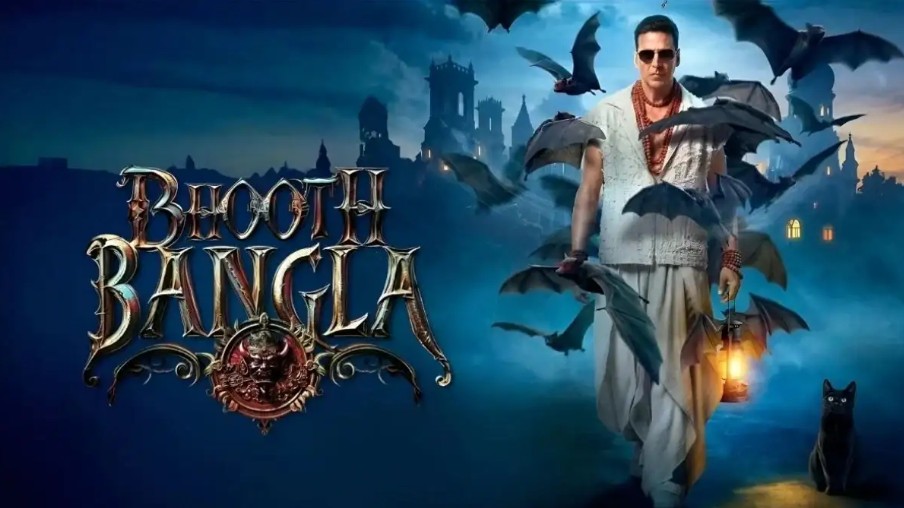
An Average attempt of Priyadarshan to re-create his OG comedy flicks.
By: Rijesh Raj Poudel
Bhooth Bangla, arrives as a Hindi-language comedy-horror that revisits a familiar tonal space for Priyadarshan, marking his return to a genre he previously shaped with Bhool Bhulaiyaa. Backed by Akshay Kumar, Ekta Kapoor, and Shobha Kapoor under Balaji Motion Pictures and Cape of Good Films, the film situates itself within a lineage of mainstream genre hybrids that blend slapstick with supernatural intrigue.
The ensemble featuring Akshay Kumar alongside Paresh Rawal, Jisshu Sengupta, Rajpal Yadav, Tabu, and Wamiqa Gabbi, signals a deliberate return to a comedic register anchored in performance-driven rhythm. The recurrence of collaborators such as Paresh Rawal and Rajpal Yadav further reinforces a sense of continuity with Priyadarshan’s earlier comic sensibilities. Released theatrically on 17 April 2026, Bhooth Bangla positions itself less as reinvention and more as an extension an attempt to re-engage with a proven tonal formula, while navigating the expectations of a contemporary audience attuned to both nostalgia and genre familiarity.
Bhooth Bangla unfolds within a familiar yet evocative premise a haunted mansion tied to the mysterious disappearance of newly married women, a curse that has quietly suspended normal life in its surroundings. Rooted in folklore and nostalgia, the film attempts to balance supernatural intrigue with old-school comedic rhythm.
The reunion of Priyadarshan and Akshay Kumar carries an inherent expectation, and while the film does not fully recapture the precision of their earlier collaborations, it retains flashes of their signature charm particularly in its opening stretch.
Akshay Kumar appears in average form, delivering a performance that has its moments but lacks the consistency and sharpness one might expect from him. Fluid shift between humour and fear. The supporting ensemble Paresh Rawal, Rajpal Yadav, and Asrani delivers moments that evoke a sense of vintage familiarity, often recalling the tonal ease of early-2000s comedies. Asrani, in particular, leaves behind a quietly memorable presence.
However, the film’s structural weaknesses become increasingly apparent as it progresses. The first half, driven by situational humour and ensemble interplay, remains engaging. The second half, however, begins to lose cohesion drifting into stretches that feel totally inconsistent, occasionally illogical, and noticeably less inventive.
The final act is where the film decisively falters. The last thirty minutes unravel much of the goodwill built earlier, with the narrative descending into a series of contrived and underdeveloped turns. What should have been a culmination instead feels like a dilution leaving the audience more perplexed than satisfied. The tonal balance collapses, and the emotional payoff remains largely unearned.
This decline is further compounded by technical inconsistencies. While the film maintains an eerie visual atmosphere overall, portions of the visual effects appear unrefined, weakening the impact of key supernatural moments. The editing, too, lacks precision, contributing to a sense of drag particularly in the latter half.
The female cast, including Tabu, Wamiqa Gabbi, and Mithila Palkar, remains underutilized, their characters largely confined to functional roles rather than narrative drivers.
And yet, despite its shortcomings, Bhooth Bangla retains a certain nostalgic warmth. At its best, it evokes the feeling of listening to ghost stories in childhood where humour and fear coexist in a comforting rhythm. Unfortunately, that charm proves difficult to sustain through its uneven latter half.
A film that begins with familiarity and promise, but ultimately loses its footing where it matters most.
My Rating: 2.5/5