
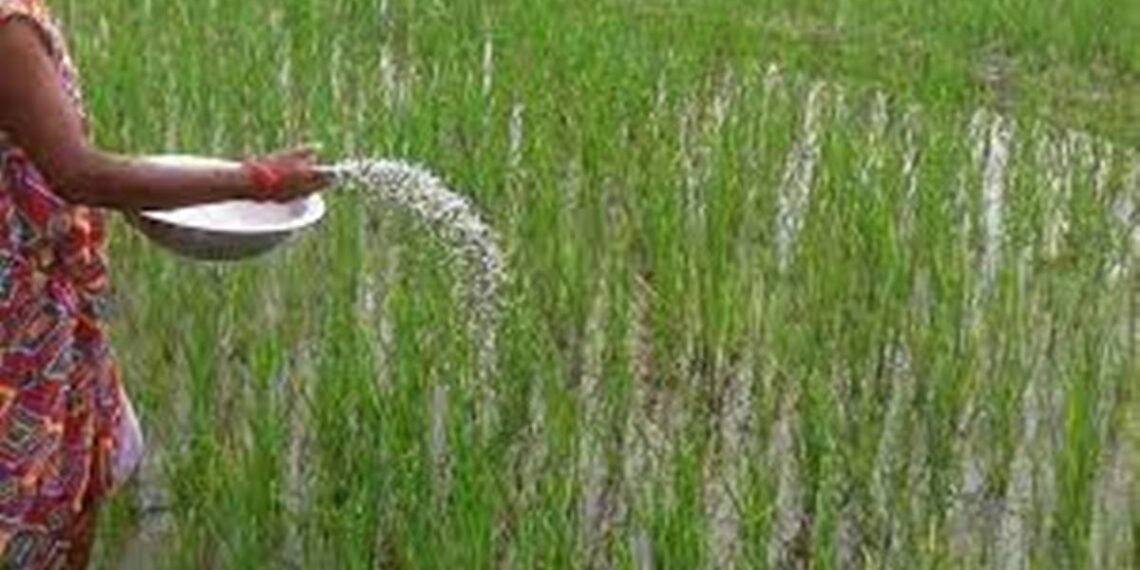
Nepal imported chemical fertilizers worth nearly Rs 50 billion during the first 11 months of the current fiscal year, but farmers across the country continue to face shortages during the peak paddy transplantation season, highlighting persistent weaknesses in the government’s supply and distribution system.

According to the Department of Customs, Nepal imported chemical fertilizers worth Rs 49.83 billion by mid-June. The imports included more than Rs 35 billion worth of urea, over Rs 12 billion worth of diammonium phosphate (DAP) and around Rs 2 billion worth of potash. Urea accounted for the largest share of total imports both in value and volume.
The Ministry of Agriculture and Livestock Development estimates Nepal’s annual demand for chemical fertilizers at around 700,000 metric tonnes, with consumption increasing each year alongside the expansion of paddy, maize, wheat and vegetable cultivation.
To support farmers, the government distributes subsidized fertilizers through the Agricultural Inputs Company Limited (AICL) and the Salt Trading Corporation (STC). More than Rs 30 billion has been allocated for fertilizer subsidies in the current fiscal year alone.
Despite the substantial imports and government subsidies, farmers frequently struggle to obtain fertilizers when they are most needed for planting.
Agriculture experts and stakeholders attribute the recurring shortages primarily to weaknesses in supply chain management rather than a lack of imports. Delays in international procurement processes, slow transportation, logistical bottlenecks between ports, warehouses and districts, and poor demand forecasting have repeatedly disrupted timely distribution.
Experts say that while some government warehouses often hold adequate fertilizer stocks, simultaneous demand during the paddy planting season overwhelms the distribution network, resulting in shortages in several districts even as surplus supplies remain elsewhere. Informal cross-border leakage and black-market trading have further aggravated the problem.
The cost of fertilizer imports has also increased due to higher international prices, fluctuations in the US dollar exchange rate and rising transportation expenses, placing additional pressure on the government’s subsidy budget.
Although Nepal has long discussed establishing a domestic fertilizer manufacturing industry to reduce dependence on imports, no production facility has yet become operational. Several feasibility studies and proposals—including projects based on natural gas and green hydrogen—have failed to move beyond the planning stage because of uncertainty over reliable raw material supplies, high capital investment requirements and concerns that domestic production would be significantly more expensive than imported fertilizers.
Experts argue that operating a fertilizer manufacturing plant in Nepal would require a stable long-term supply of energy and raw materials, making the commercial viability of such an industry a major challenge. They emphasize that while domestic production could strengthen Nepal’s long-term fertilizer security, immediate improvements in procurement planning, storage, transportation and distribution systems are essential to ensure that fertilizers reach farmers on time during critical planting seasons.