
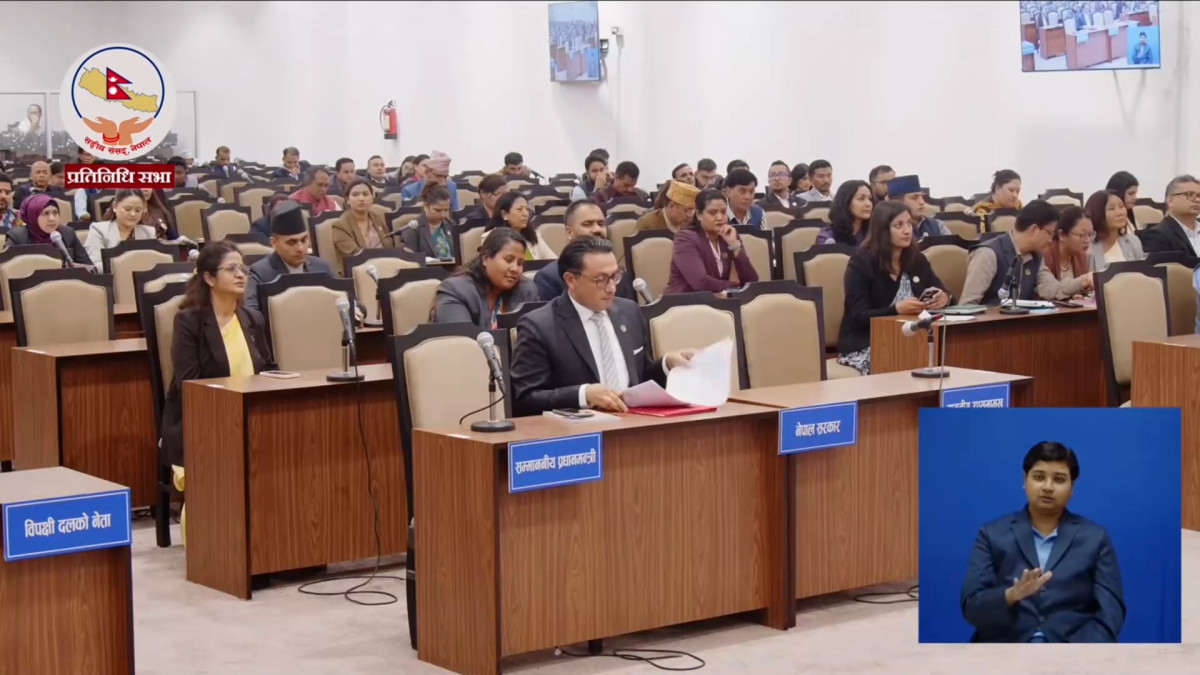
Despite enjoying the support of nearly two-thirds of Parliament, the government has presented a budget for fiscal year 2026/27 that reduces the share of capital expenditure, raising concerns about its commitment to infrastructure development and economic growth.

The government led by Prime Minister Balendra Shah has allocated Rs 431.10 billion, or 20.3 percent of the Rs 2.124 trillion budget, for capital expenditure. This is slightly lower than the 20.8 percent share allocated in the current fiscal year, disappointing expectations that a strong government would increase development spending.
Former Vice-Chairman of the National Planning Commission, Dr. Prakash Kumar Shrestha, criticized the budget for lacking a clear vision, arguing that major infrastructure projects should have received greater priority instead of smaller programs. He also pointed out that both the size of the capital budget and the government’s ability to spend it remain inadequate.
Capital expenditure finances long-term investments such as roads, bridges, energy projects, irrigation systems, schools, and hospitals. Economists believe higher development spending is essential to boost production, attract private investment, and create employment opportunities. However, Nepal continues to face structural challenges, including poor project preparation, procurement delays, land acquisition issues, environmental clearances, administrative inefficiency, and frequent staff transfers.
Government spending performance remains weak. By mid-June, only 32.91 percent of the current year’s capital budget had been utilized, with just Rs 134 billion spent out of the allocated Rs 407.88 billion. This was lower than the 41.35 percent utilization recorded during the same period last year. Overall expenditure reached 69.6 percent of the total budget, compared to 74 percent a year earlier.
Experts warn that recurrent expenditures—such as salaries, allowances, social security payments, and administrative costs—continue to consume the majority of government resources, leaving limited room for development spending. This trend could slow infrastructure expansion, increase production costs for the private sector, and weaken long-term economic growth prospects.
Former NPC Vice-Chairman Dr. Govind Raj Pokharel said the reduced development budget makes the government’s target of achieving 7 percent economic growth unrealistic. He argued that the existing expenditure structure itself is too weak to support such ambitious growth.
Meanwhile, Dr. Gunakar Bhatt, Vice-Chairman of the National Planning Commission, acknowledged the challenge but said the government is working to improve ministries’ capacity to implement infrastructure projects and expand development activities.
Although officials maintain that reforms are underway to improve spending efficiency, economists emphasize that without fundamental improvements in project execution, procurement systems, and administrative capacity, Nepal’s growth ambitions will remain difficult to achieve.