

The government has ramped up market inspections across the Kathmandu Valley as the shortage of cooking gas worsens ahead of the upcoming election.

Narahari Tiwari, director at the Department of Commerce, Supplies and Consumer Protection (DoCSCP), said a joint inspection team involving the department, the Nepal Oil Corporation (NOC), and the Nepal Bureau of Standards and Metrology began monitoring the market on Monday. He said the initiative was launched in response to a surge in complaints filed with the DoCSCP regarding the ongoing liquefied petroleum gas (LPG) shortage.
According to the DoCSCP, four inspection teams have been mobilized to oversee LPG distribution by major gas dealers in areas including Kirtipur, Kuleshwor, Kalanki, Sohrakhutte, Balaju, Gongabu Bus Park, Koteshwor, and Bhaktapur. The teams are also inspecting business outlets, hotels, and restaurants to check for possible hoarding of cooking gas.
Tiwari said the teams are authorized to impose fines of up to Rs 300,000 on anyone found storing excessive quantities of LPG.
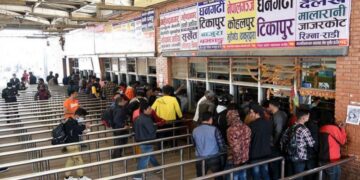
For the past several weeks, residents of the Kathmandu Valley have been facing difficulties in obtaining daily household essentials. Babita Karki, a resident of Pasikot in Budhanilkantha, said she has been standing in line for nearly three weeks to buy a cooking gas cylinder, with no assurance of when she will finally receive it.
According to the NOC, Nepal requires around 90 LPG bullets—equivalent to about 114,000 cylinders—each day. However, gas bottlers said demand has risen by around 15 percent due to the winter season and increased hoarding by households concerned about potential shortages during the election, which is less than three weeks away.
The NOC maintains that it has been issuing 10 percent more purchase delivery orders to ensure a steady supply. Based on these orders, gas importers collect LPG from Indian Oil Corporation depots in Barauni, Mathura, and Haldia.
NOC officials also claim that the current shortage is largely artificial and fueled by rumors. Despite repeated appeals urging consumers not to stockpile cooking gas unnecessarily, the situation has yet to improve.