
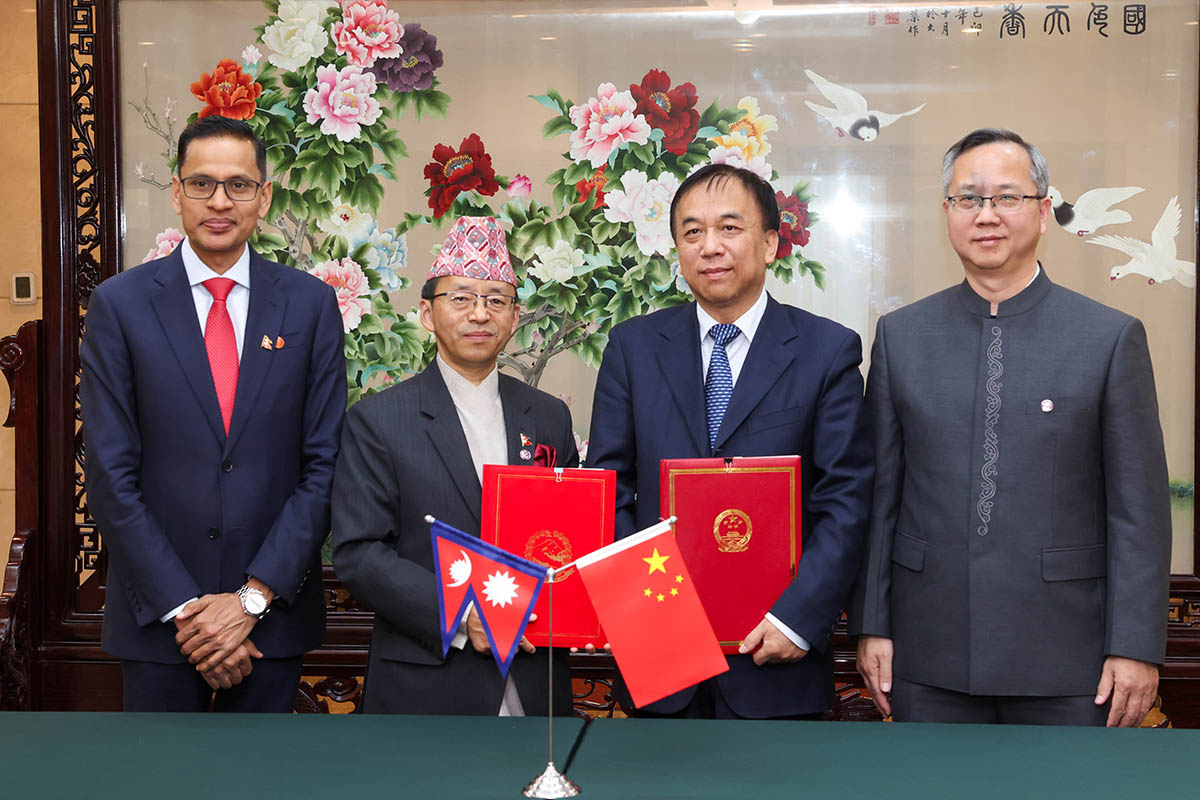
After weeks of debate and uncertainty, Nepal and China have signed the Framework for Belt and Road Initiative (BRI) Cooperation agreement in Beijing. The agreement, finalized on Wednesday during Prime Minister KP Sharma Oli’s visit to China, marks a significant step toward implementing BRI-related projects in Nepal.

“Today, we signed the Framework for Belt and Road Cooperation,” Prime Minister Oli announced on X (formerly Twitter). “As my official visit to China concludes, I am honored to reflect on bilateral talks with Premier Li Qiang, discussions with NPC Chairman Zhang Leji, and a highly fruitful meeting with President Xi Jinping.”
The agreement was signed by Acting Foreign Secretary Amrit Bahadur Rai on behalf of Nepal and Deputy Head of the National Development and Reform Commission Liu Sushe on behalf of China. The signing ceremony took place just a day before Prime Minister Oli concludes his four-day official visit.
Negotiations and Agreement Terms
Initially, the signing faced hurdles due to Nepal’s reluctance to accept a loan agreement for implementing BRI projects. After intense negotiations, both sides reached a middle ground on Wednesday.
Nepal’s initial proposal for a “grant financing cooperation modality” was revised by China to “assistance financing modality.” Ultimately, both sides agreed on the term “aid assistance financing.”
The Nepalese negotiation team was led by Prime Minister Oli’s advisor Yubaraj Khatiwada and Foreign Minister Arzu Rana Deuba, while China’s delegation included senior officials from the Ministry of Foreign Affairs. Details of the framework agreement remain undisclosed as of Wednesday.
Joint Statement and Key Agreements
In a 12-point joint statement issued earlier, Nepal and China reaffirmed their commitment to enhancing bilateral relations and regional connectivity under the BRI. Both sides emphasized infrastructure development through the Trans-Himalayan Multi-Dimensional Connectivity Network.
“The two sides expressed readiness to sign the MoU on building the Trans-Himalayan Multi-Dimensional Connectivity Network and the Framework for Belt and Road Cooperation as soon as possible,” the statement read.
Priority Projects under the Framework
Under the new agreement, Nepal and China have prioritized 10 projects for development. While Nepal initially proposed 12 projects, two were excluded: the Kathmandu-Hetauda Pod-way and Kathmandu Valley Transmission Line.
The agreed projects include:
- Tokha-Chhahare Tunnel
- Hilsa-Simkot Road
- Kimathanka-Khandbari Road and Bridge
- Geelong-Kerung-Kathmandu Transborder Railway
- Geelong-Kerung-Chilime 220 kV Cross-Border Transmission Line
Other projects feature the Madan Bhandari University, Kathmandu Scientific Center and Science Museum, China-Nepal Industrial Friendship Park in Damak, Jhapa Sports Academy in Damak, and Amargadhi City Hall in Dadeldhura.
Sources revealed that the Sports Academy in Jhapa and Amargadhi City Hall were included at Nepal’s special request to accommodate constituencies of key political leaders, including Prime Minister Oli and former Prime Minister Sher Bahadur Deuba.
Background and Framework Significance
Although Nepal joined the BRI in 2017, no projects had been implemented until now. China had been urging Nepal to finalize the BRI Implementation Plan, but differences within Nepal’s political parties, particularly over loan-based projects, delayed progress.
A cross-party task force recommended prioritizing a framework agreement to provide structural arrangements and clear guidelines for implementing BRI projects.
“The earlier MoU lacked structural clarity,” explained Semanta Dahal, a task force member and international law expert. “This new framework emphasizes alignment with Nepal’s economic priorities and ensures value-for-money principles.”
With the Framework for BRI Cooperation now in place, Nepal is set to advance its infrastructure and regional connectivity efforts, potentially unlocking significant economic benefits.