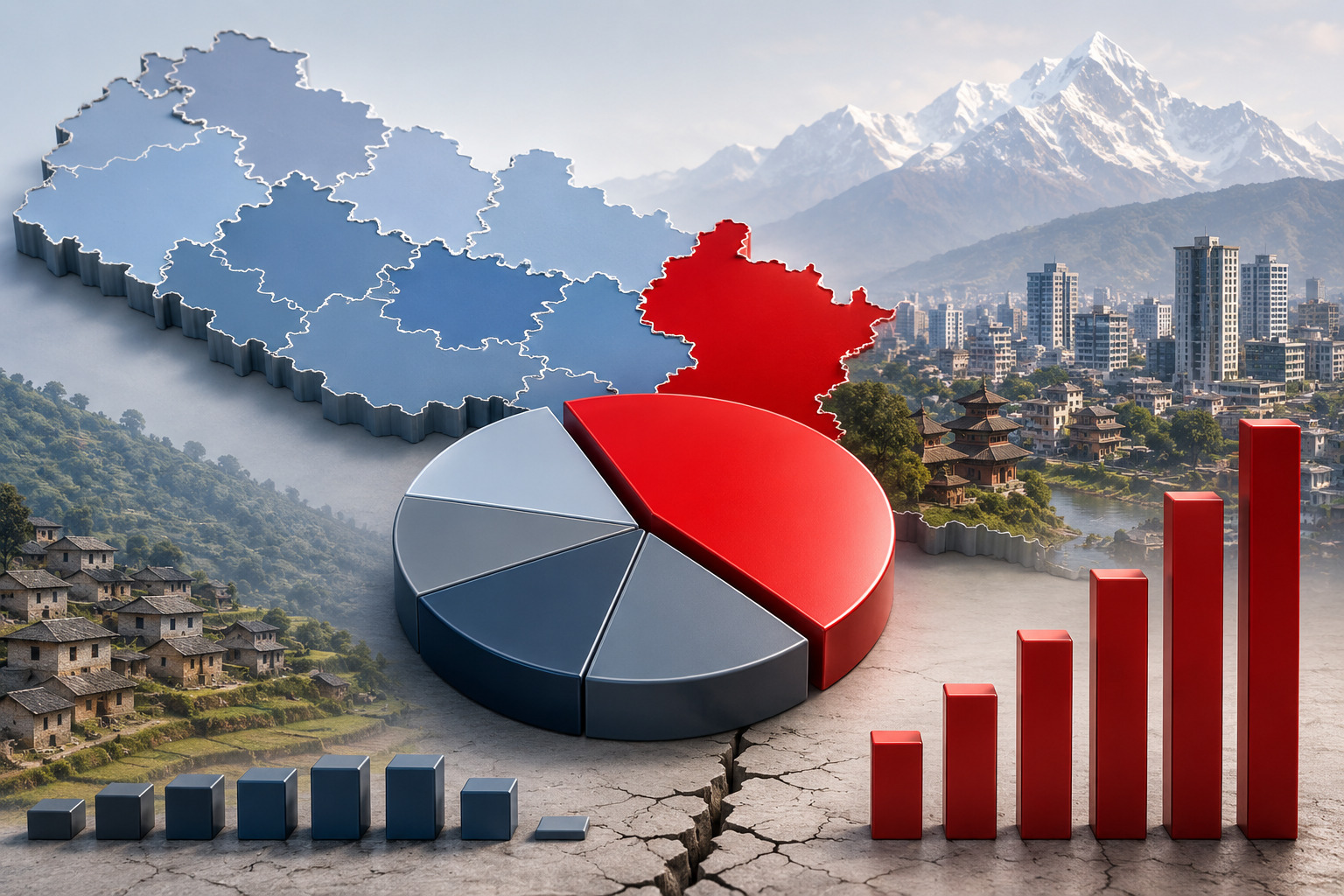
Bagmati Province contributes 36.71 percent of Nepal’s gross domestic product (GDP), making it the country’s largest economic hub, while geographically remote Karnali Province contributes only 4.20 percent, highlighting significant regional imbalances, according to a half-yearly province-wise study report released by the Nepal Rastra Bank (NRB).
Among the remaining provinces, Koshi Province contributes 15.80 percent, followed by Lumbini Province with 14.20 percent, and Madhesh Province with 13.08 percent. Gandaki Province, known for its tourism potential, accounts for 8.98 percent, while Sudurpaschim Province contributes 7.03 percent.
The report shows that Bagmati Province alone generates more than one-third of Nepal’s economy, whereas the remaining six provinces share the rest amid relatively lower levels of economic activity.
Growth Rates Also Vary Sharply
The central bank report points to wide differences in economic growth among provinces. Owing to strong expansion in the services and infrastructure sectors, Bagmati Province is projected to grow by 5.40 percent in the current fiscal year, while Gandaki Province is expected to record 5.01 percent growth.
In contrast, Madhesh Province’s growth is projected at only 1.31 percent, indicating an economic slowdown across the Terai region.
According to the NRB, weak infrastructure, traditional agriculture practices, and limited capacity for budget execution at the local level have prevented provinces such as Karnali, Sudurpaschim, and Madhesh from achieving expected economic progress. The report notes that the concentration of development priorities around Kathmandu and surrounding areas has prevented remote regions from fully benefiting from federalism.
Banking Resources Highly Concentrated in Bagmati
The report further highlights the unequal distribution of financial resources. Bagmati Province holds 65.52 percent of total deposits collected by banks and financial institutions and receives 60.33 percent of total credit disbursement nationwide.
By comparison:
- Karnali Province accounts for only 1.22 percent of deposits and 1.11 percent of credit flow.
- Sudurpaschim Province receives 2.35 percent of deposits and 2.79 percent of credit.
- Madhesh Province holds 5.54 percent of deposits and receives 8.67 percent of total lending.
The NRB observed that although banks have expanded branches into rural areas and mobilized deposits there, most of those funds are concentrated in urban centers, particularly Bagmati Province, with lending largely directed toward major commercial sectors. This has limited investment opportunities in remote regions and widened regional inequalities.
Agricultural Contributions Also Uneven
The disparity is also evident in the agricultural sector. Koshi Province contributes 21.36 percent to agricultural development, whereas Karnali Province contributes only 5.51 percent, underscoring the uneven pace of economic development across Nepal.
The NRB report concludes that unless financial resources, infrastructure development, and investment opportunities are distributed more evenly among provinces, regional inequality is likely to persist despite the country’s federal structure.