
CEO Tab
  • Home
  • Prime News
  • International Market
  • Special Report
  • Corporate
  • Opinion
  • Next Gen
  • Entertainment
No Result
View All Result
CEO Tab
  • Home
  • Prime News
  • International Market
  • Special Report
  • Corporate
  • Opinion
  • Next Gen
  • Entertainment
No Result
View All Result
CEO Tab
No Result
View All Result
Home Prime News

Bagmati Accounts for 36.71% of Nepal’s GDP, Revealing Wide Regional Economic Disparities

CEO Tab by CEO Tab
June 22, 2026
in Prime News
0
Bagmati Accounts for 36.71% of Nepal’s GDP, Revealing Wide Regional Economic Disparities
75
SHARES
1.3k
VIEWS
Share on FacebookShare on Twitter

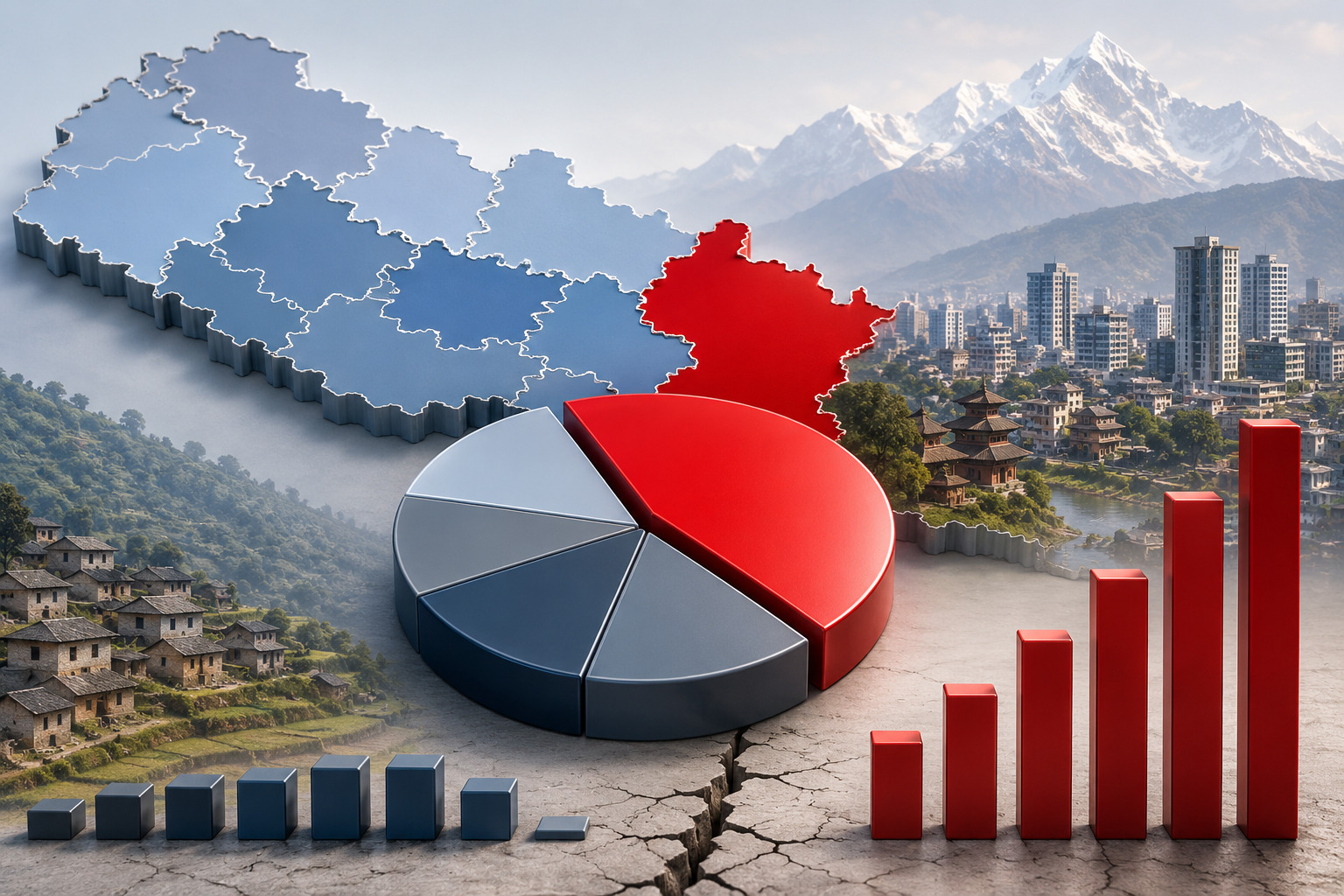
Bagmati Province contributes 36.71 percent of Nepal’s gross domestic product (GDP), making it the country’s largest economic hub, while geographically remote Karnali Province contributes only 4.20 percent, highlighting significant regional imbalances, according to a half-yearly province-wise study report released by the Nepal Rastra Bank (NRB).

You might also like

Nepal’s Consumer Inflation Surges to 6.37 Percent in Mid-October

Nepal’s Foreign Currency Reserves Rise 6.8% to Rs 4.16 Trillion

Nepal Receives Rs 703.70 Billion in Remittances in First Three Months, Up 27.2 Percent

Among the remaining provinces, Koshi Province contributes 15.80 percent, followed by Lumbini Province with 14.20 percent, and Madhesh Province with 13.08 percent. Gandaki Province, known for its tourism potential, accounts for 8.98 percent, while Sudurpaschim Province contributes 7.03 percent.

The report shows that Bagmati Province alone generates more than one-third of Nepal’s economy, whereas the remaining six provinces share the rest amid relatively lower levels of economic activity.

Growth Rates Also Vary Sharply

The central bank report points to wide differences in economic growth among provinces. Owing to strong expansion in the services and infrastructure sectors, Bagmati Province is projected to grow by 5.40 percent in the current fiscal year, while Gandaki Province is expected to record 5.01 percent growth.

In contrast, Madhesh Province’s growth is projected at only 1.31 percent, indicating an economic slowdown across the Terai region.

According to the NRB, weak infrastructure, traditional agriculture practices, and limited capacity for budget execution at the local level have prevented provinces such as Karnali, Sudurpaschim, and Madhesh from achieving expected economic progress. The report notes that the concentration of development priorities around Kathmandu and surrounding areas has prevented remote regions from fully benefiting from federalism.

Banking Resources Highly Concentrated in Bagmati

The report further highlights the unequal distribution of financial resources. Bagmati Province holds 65.52 percent of total deposits collected by banks and financial institutions and receives 60.33 percent of total credit disbursement nationwide.

By comparison:

  • Karnali Province accounts for only 1.22 percent of deposits and 1.11 percent of credit flow.
  • Sudurpaschim Province receives 2.35 percent of deposits and 2.79 percent of credit.
  • Madhesh Province holds 5.54 percent of deposits and receives 8.67 percent of total lending.

The NRB observed that although banks have expanded branches into rural areas and mobilized deposits there, most of those funds are concentrated in urban centers, particularly Bagmati Province, with lending largely directed toward major commercial sectors. This has limited investment opportunities in remote regions and widened regional inequalities.

Agricultural Contributions Also Uneven

The disparity is also evident in the agricultural sector. Koshi Province contributes 21.36 percent to agricultural development, whereas Karnali Province contributes only 5.51 percent, underscoring the uneven pace of economic development across Nepal.

The NRB report concludes that unless financial resources, infrastructure development, and investment opportunities are distributed more evenly among provinces, regional inequality is likely to persist despite the country’s federal structure.


Share30Tweet19
CEO Tab

CEO Tab

Recommended For You

Nepal’s Consumer Inflation Surges to 6.37 Percent in Mid-October

by CEO Tab
November 20, 2026
0
Nepal’s Consumer Inflation Surges to 6.37 Percent in Mid-October

Consumer price inflation in Nepal surged to 6.37 percent in mid-October of the current fiscal year, more than four times the 1.47 percent recorded during the same period...

Read more

Nepal’s Foreign Currency Reserves Rise 6.8% to Rs 4.16 Trillion

by CEO Tab
November 20, 2026
0
Nepal’s Foreign Currency Reserves Rise 6.8% to Rs 4.16 Trillion

Nepal’s foreign currency reserves increased by 6.8 percent to reach Rs 4.16 trillion as of mid-October in the current fiscal year, strengthening the country’s capacity to finance imports....

Read more

Nepal Receives Rs 703.70 Billion in Remittances in First Three Months, Up 27.2 Percent

by CEO Tab
November 20, 2026
0
Nepal Receives Rs 703.70 Billion in Remittances in First Three Months, Up 27.2 Percent

Nepal received remittances worth Rs 703.70 billion in the first three months of the current fiscal year, marking a 27.2 percent increase compared to the same period last...

Read more

NEA to Sign Power Purchase Agreements for 1,000 MW of Government-Owned Projects

by CEO Tab
November 20, 2026
0
NEA to Sign Power Purchase Agreements for 1,000 MW of Government-Owned Projects

The Nepal Electricity Authority (NEA) is preparing to sign Power Purchase Agreements (PPAs) for around 1,000 MW of electricity generated by government-owned companies, paving the way for faster...

Read more

NEA Secures Approval to Import 350 MW of Electricity from India for Winter

by CEO Tab
November 18, 2026
0
NEA Secures Approval to Import 350 MW of Electricity from India for Winter

The Nepal Electricity Authority (NEA) has received approval to import 350 MW of electricity from India to meet domestic demand during the upcoming winter season. India’s Central Electricity...

Read more
Next Post
Government Unveils Commercial Policy Implementation Action Plan 2081 to Boost Exports and Reduce Trade Deficit

Government Unveils Commercial Policy Implementation Action Plan 2081 to Boost Exports and Reduce Trade Deficit

Browse by Category

  • Corporate
  • Entertainment
  • Featured
  • International
  • Major Story
  • Next Gen
  • Opinion
  • Prime News
  • Special Report
  • Tete – A – Tete

EDITOR

Manish Raj Poudel
info@ceotab.com
9841317747


PUBLISHED BY

Welcome Group
www.welcomeadnepal.com

Publisher

www.ceotab.com is a premium news portal being run by Welcome Group. The website features quality business/economic news contents,  in-depth profiles of companies, stories of struggle and success of entrepreneurs, articles that assess various dimensions of  the commerce, trade and economy.

Editor

Manish Raj Poudel

info@ceotab.com

9841317747

Sub-Editor

Riza Poudel

poudelriza@gmail.com

Archives

© 2023 CEO Tab. All rights reserved.

No Result
View All Result
  • Home
  • Prime News
  • International Market
  • Special Report
  • Corporate
  • Opinion
  • Next Gen
  • Entertainment

© 2023 CEO Tab. All rights reserved.