

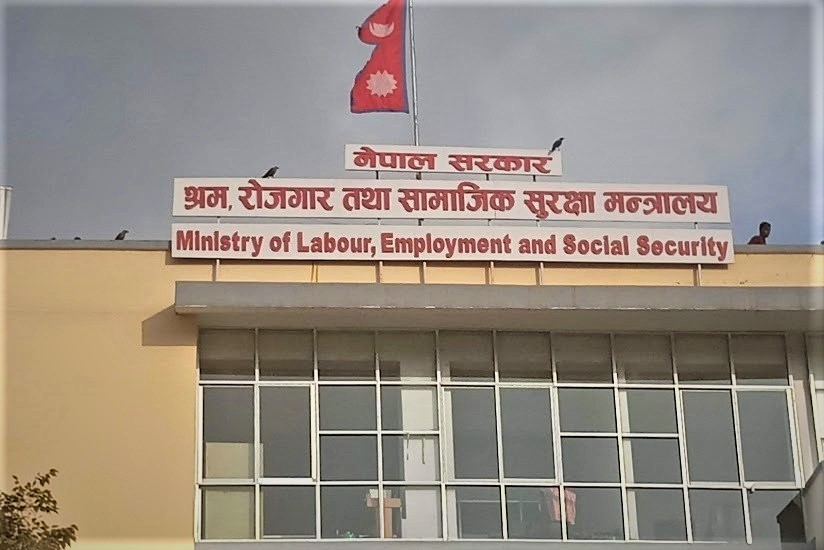
Kathmandu: The government has launched two major reform initiatives aimed at curbing irregularities in Nepal’s foreign employment sector and making services more accessible and secure for migrant workers. The Ministry of Labour, Employment and Social Security has officially launched the “Operation Illegal Agent Clean-Up” campaign while initiating the process of providing labour approval services through all 753 local governments across the country.
Minister for Labour, Employment and Social Security Ramji Yadav formally inaugurated both programmes during a virtual interaction with employment coordinators from local governments and counsellors from Migration Resource Centres nationwide.
According to Minister Yadav, although Nepal’s foreign employment laws do not recognize the agent system, illegal intermediaries continue to operate extensively, exposing migrant workers to fraud and financial exploitation. An analysis of complaints registered since 1999 (2056 BS) revealed that the majority of grievances were linked to unauthorized agents. The government, therefore, aims to identify such individuals, take legal action against them, and make foreign employment services more transparent.
To support the campaign, the ministry has developed a dedicated online portal and mobile application that will enable authorities to collect information on individuals or groups involved in fraudulent foreign employment practices. Minister Yadav described the initiative as more than just a complaint registration system, saying it marks the beginning of data-driven governance that will strengthen evidence-based policymaking and improve accountability in enforcement.
In a parallel reform, the government is expanding labour approval services through the Foreign Employment Information Management System (FEIMS) so that workers will no longer need to travel to Kathmandu for routine approvals. The ministry said user IDs have already been created for 390 local governments, while services will be gradually extended to the remaining municipalities and rural municipalities.
The ministry has also endorsed new operational guidelines to transform existing Employment Service Centres into integrated Employment, Skills and Entrepreneurship Centres, with greater responsibilities assigned to local employment coordinators. Coordination between Migration Resource Centres and local governments is expected to ensure more effective delivery of foreign employment services.
Officials believe the decentralization of labour approval services will particularly benefit citizens with limited digital literacy by allowing them to access free and convenient services from their own local governments. The initiative is also expected to help reduce cyber fraud, eliminate middlemen, and curb the financial exploitation of migrant workers.
Minister Yadav said good governance is not merely about introducing new laws but about ensuring that citizens experience fairness, efficiency, and convenience when accessing public services. He also announced the government’s plan to observe the next ten years as the “National Employment Promotion Decade.”
“Creating decent and formal employment opportunities within Nepal while ensuring safe foreign employment remains one of the government’s primary responsibilities,” Minister Yadav said. He urged employment coordinators in all 753 local governments to actively serve as the ministry’s representatives and work to earn the trust of citizens through effective service delivery.