

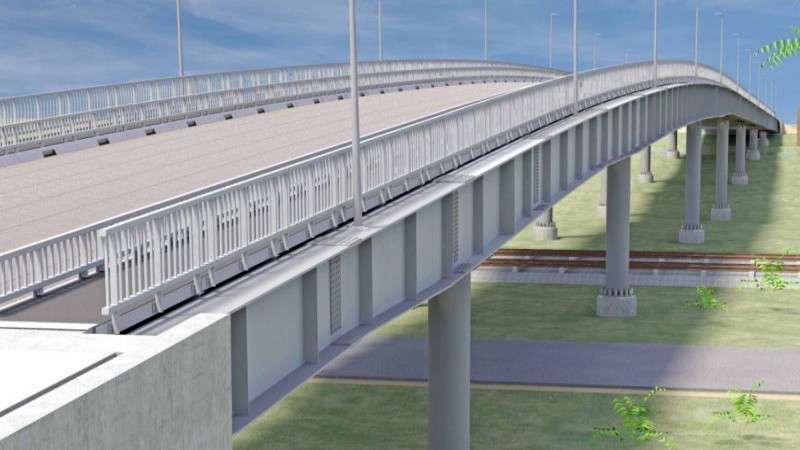
The Government of Nepal has signed a loan agreement with the Government of Japan to construct an underpass and flyover along the Koteshwor–Jadibuti section. Nepal and Japan agreed on a loan of NPR 31.76 billion for the Koteshwor Intersection Improvement Project.

At a program held in Kathmandu, representatives from both countries exchanged documents and finalized the agreement. The project, to be operated with support from the Japan International Cooperation Agency (JICA), is expected to bring long-term improvements to traffic management in the Kathmandu Valley.
Once the flyovers and underpass are built, vehicular movement along Kathmandu, Lalitpur, Bhaktapur and the BP Highway is expected to become smoother, significantly reducing traffic congestion. The project will be implemented through the Department of Roads under the Ministry of Physical Infrastructure and Transport.
The loan agreement was signed in the presence of Finance Minister Rameshwor Prasad Khanal at a ceremony organized at the Ministry of Finance on Wednesday. Japan has provided concessional loan assistance equivalent to 34.59 billion Japanese Yen, approximately NPR 31.76 billion. According to the ministry, the loan will have a grace period of 10 years, a repayment period of 30 years and an annual interest rate of 0.2 percent.
Finance Secretary Dr. Ghanshyam Upadhyay and Japanese Ambassador to Nepal, Maeda Toru, signed the related loan agreement. Likewise, Joint Secretary Dr. Dhaniram Sharma from the International Economic Cooperation Division and JICA Nepal Chief Representative Mitsuzaki Masuki signed the implementation agreement.
Following the signing ceremony, JICA Nepal Chief Representative Mitsuzaki Masuki, Ambassador Maeda Toru and Minister Khanal expressed commitment to strengthening bilateral cooperation and advancing the project effectively.
The Japanese ambassador highlighted that the project, executed through Japan’s concessional loan, would significantly improve the Valley’s traffic system. Addressing the event, Minister Khanal said the project’s objective is to ease traffic congestion in one of Kathmandu’s busiest areas, ensuring long-term improvement in urban traffic management.
The program was attended by senior officials from the Ministry of Finance, Ministry of Physical Infrastructure and Transport, Department of Roads, the Japanese Embassy and JICA Nepal. According to the ministry, the cabinet meeting held on Bhadra 2 had approved the concessional loan agreement for constructing two flyovers and one underpass in Koteshwor.
Flyover and Underpass in Koteshwor
JICA has already completed the preliminary feasibility study for the flyover and underpass. As per the design, a 600-meter-long flyover will be constructed from the Thapagaun–Tinkune bridge up to the area near Munibhairav Temple in Koteshwor. From near the temple, a 700-meter-long underpass will be built stretching toward Jadibuti, along the eastern perimeter of Tribhuvan International Airport.
Another flyover, 238 meters long, will connect Jadibuti Chowk to the Manohara River bridge, according to the department. The ministry stated that, unlike the model used in Gwarko, the Koteshwor flyover will be built with pillars spaced intermittently. The underpass will follow the “cut-and-cover” model, not a deep-excavation tunnel like the one built in Nagdhunga.
Because the terrain is relatively flat, engineers from the ministry noted that the cut-and-cover method is suitable for Koteshwor.
JICA plans to complete all construction work by August 2033. A detailed timeline has been prepared from contract signing to final handover.
According to the official work schedule:
- Loan signing: September 2025
- Loan effectiveness: December 2025
- Appointment of consultants: May 2026
- Detailed design preparation: June 2026 – May 2027
- Contractor selection: June 2027
- Contract signing: April 2028
- Project completion: August 2033
The Ministry stated that the Civil Aviation Authority of Nepal (CAAN) has responded positively to building an underpass in Koteshwor. JICA had studied multiple alternatives to reduce traffic congestion in the area before this model was finalized.