
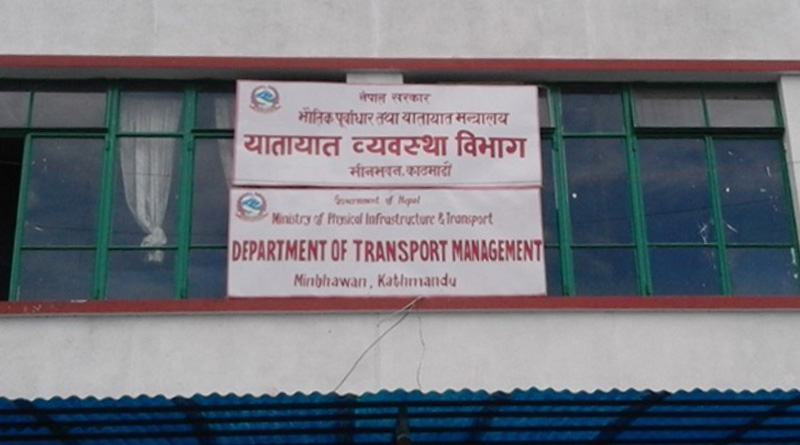
The Department of Transport Management (DoTM) under the Ministry of Physical Infrastructure and Transport has partially lifted its indefinite suspension on the registration of public transport vehicles.

According to DoTM Director Maniram Bhusal, the department has decided to allow the registration of public vehicles for which Letters of Credit (LCs) had already been opened and whose import process had been initiated before the restriction came into effect. The department issued a circular to all seven provincial governments and local bodies on Monday regarding the decision.
Under the new arrangement, importers who had opened LCs and initiated import procedures by May 22, 2026 (Jestha 8, 2083 BS), and whose vehicles have already entered Nepal, will be allowed to complete the registration process after submitting the required documents.
The circular states that if the submitted documents confirm that the LC had been opened and the import process had commenced on or before Jestha 8, 2083, and the vehicles have already arrived in Nepal, there will be no obstacle to registering those public vehicles.
Registration Had Been Suspended Indefinitely
On April 20, 2026 (Baisakh 7, 2083 BS), the department had instructed provincial and local authorities to halt the registration of public transport vehicles indefinitely, citing several concerns:
- Lack of scientific management of public transportation;
- Rising air pollution;
- Increasing traffic congestion and road overcrowding; and
- Severe difficulties faced by commuters due to excessive vehicle density.
As a result, the registration of new public transport vehicles was suspended nationwide.
Bagmati Province Defied Federal Decision
Despite the federal government’s directive, Bagmati Province chose not to enforce the suspension. On June 2, 2026 (Jestha 19, 2083 BS), the provincial government instructed offices under its jurisdiction to continue registering public transport vehicles.
The latest decision by the Department of Transport Management effectively provides relief to importers whose vehicles had already been ordered and transported to Nepal before the registration ban was imposed.
The issue has also highlighted growing tensions between the federal and provincial governments regarding authority over transport regulation and public vehicle registration under Nepal’s federal structure.