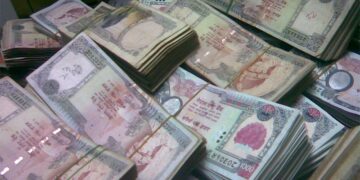


As the fiscal year nears its end, the Government of Nepal has once again engaged in significant last-minute budget transfers, raising serious concerns over its adherence to fiscal discipline. According to a recent report from the Ministry of Finance (MoF), government agencies transferred over Rs 4.40 billion between mid-April and mid-May alone—a move experts and oversight bodies warn could lead to inefficiency and corruption.

During this one-month period, 43 government bodies were involved in budget reallocations. Of these:
- 20 projects were under the Ministry of Physical Infrastructure and Transport,
- 12 projects came under the Ministry of Urban Development,
- 4 projects belonged to the Ministry of Home Affairs, and
- 3 projects each were related to energy and drinking water, while 1 project was under the Ministry of Education.
The largest transfer, exceeding Rs 1.1 billion, was from the Kathmandu-Tarai-Madhesh Fast Track Project, with Rs 900 million redirected to tunnel highway development and Rs 200 million to the expansion of industrial corridor commercial routes. Even the Office of the President received an additional Rs 5.62 million.
This year’s mid-April to mid-May figure is notably higher than the Rs 2.40 billion transferred during the same period last fiscal year, pointing to a worsening trend of arbitrary budget shifts.
What Are Budget Transfers?
Budget transfers refer to the reallocation of funds from one project or program to another. While permitted under exceptional circumstances, they are often used by ministries and departments that fail to spend funds as originally earmarked. This practice disrupts planned project implementation and fosters a culture of reactive, rather than strategic, budgeting.
Rampant Transfers Reflect Deeper Governance Issues
Nepal’s government has a long-standing habit of rushing development expenditures in the final weeks of the fiscal year—primarily to meet deadlines and avoid criticism for underutilization of the capital budget. This often results in substandard construction, poor financial accountability, and avoidable public inconvenience, especially with infrastructure projects.
As of Asar 21 (July 5), the government had utilized only Rs 168.03 billion—47.69 percent of the capital expenditure allocated for the fiscal year, which stands at Rs 352.35 billion. This mirrors the inefficient trend observed in previous years:
- In FY 2023/24, budget transfers totaled Rs 256.41 billion of the Rs 1.751 trillion annual budget.
- Then Finance Minister Barsha Man Pun alone transferred Rs 26.90 billion in the last month of that fiscal year, including Rs 15.98 billion in the final week—in violation of legal restrictions.
Similarly, Prakash Sharan Mahat, Finance Minister at the time, conducted Rs 11.64 billion in transfers in the first three months of FY 2023/24, although the law prohibits budget transfers in the first quarter of any fiscal year.
Institutional Oversight & Legal Provisions Ignored
The Office of the Auditor General (OAG) continues to flag such irregularities in its annual reports, highlighting last-minute transfers as a key contributor to financial mismanagement in the bureaucracy. Meanwhile, the Financial Comptroller General Office (FCGO) has banned all three tiers of government from making unnecessary expenditures in the final week of the fiscal year. Yet, in a predictable move, the MoF accelerates budget transfers just before the FCGO’s cut-off—effectively skirting accountability.
The Bigger Picture
These practices reflect systemic weaknesses in budget planning, execution, and oversight. Rather than building institutional capacity for year-round project implementation, the government continues to allow a fiscal free-for-all at the year-end, eroding trust and undermining service delivery. Until laws are enforced and fiscal responsibility prioritized, Nepal’s budget credibility will remain in question, with taxpayers footing the cost of inefficiency.