
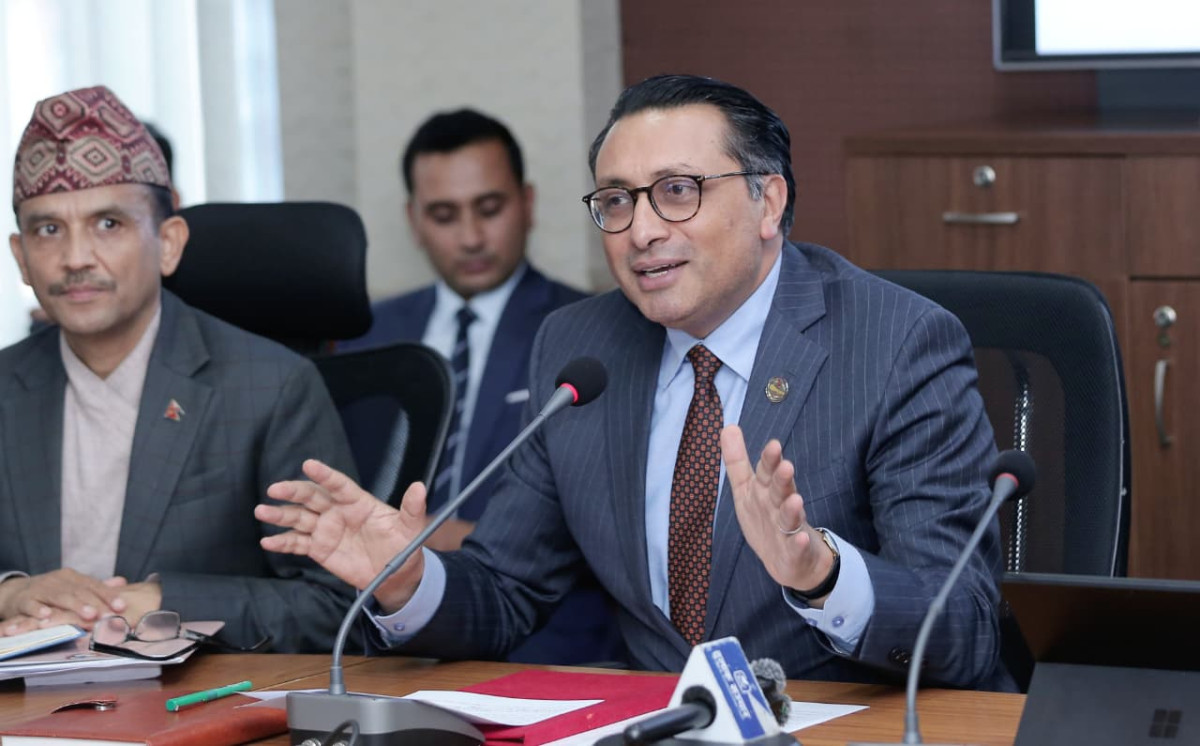
Finance Minister Dr. Swarnim Wagle has stressed the need to amend the Nepal Rastra Bank (NRB) Act to make the central bank more proactive, effective and accountable while strengthening coordination with the Ministry of Finance.

Speaking at a meeting of the House of Representatives’ Finance Committee during clause-by-clause discussions on the bill to amend the Nepal Rastra Bank Act, 2058, Wagle said fiscal and monetary policies are closely interconnected in Nepal’s economy and require continuous coordination between the government and the central bank.
He supported the proposal to maintain a seven-member NRB Board of Directors, stating that the finance secretary’s presence on the board would become even more important after removing the government’s authority to issue direct instructions to the central bank.
Highlighting Nepal’s macroeconomic constraints, Wagle noted that the country’s fixed exchange rate with the Indian rupee and imported inflation limit the effectiveness of an independent monetary policy. Referring to the economic concept of the “Impossible Trinity,” he said no country can simultaneously maintain a fixed exchange rate, free capital movement and complete monetary policy independence.
The finance minister also proposed reducing the number of deputy governors from three to two, arguing that the existing structure of executive directors is sufficient to support the central bank’s operations.
He further called for clearer eligibility criteria for NRB board members, including provisions allowing professionals with executive-level experience in international financial institutions to serve on the board. Wagle emphasized the need to clearly define “executive level” to avoid legal ambiguity.
He added that the NRB Board should include experts from diverse fields, including economics, monetary policy, banking, finance, management, public administration, law, statistics and mathematics, to strengthen the institution’s governance and policy-making capacity.