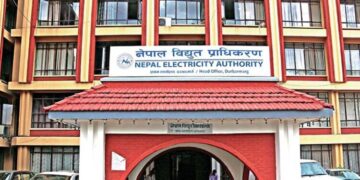


Millennium Challenge Account (MCA) Nepal, the agency responsible for executing the Millennium Challenge Corporation (MCC) grant, has come under criticism for its low spending performance in the current fiscal year 2024/25. According to the Ministry of Finance, MCA Nepal spent only Rs 1.92 billion in the first nine months of the fiscal year, far below the expected amount.
The government had allocated a total of Rs 13.36 billion to MCA Nepal for the year, including Rs 1.24 billion for recurrent expenditure and Rs 12.12 billion for capital expenditure. By mid-April, the agency was expected to have spent Rs 7.13 billion—Rs 845.8 million on recurrent items and Rs 6.28 billion on capital projects. In reality, MCA Nepal managed to spend only Rs 465 million in recurrent and Rs 1.43 billion in capital expenditure, totaling just 14.2 percent of its annual budget. This includes only 37.5 percent of the recurrent budget and 11.9 percent of the capital budget. Stakeholders have expressed concern over this sluggish spending, arguing that it reflects weak implementation and poor progress on the ground.
One of the main reasons for the low expenditure is the suspension of the MCC grant by the United States during Falgun (mid-February to mid-March). Although no final decision has been made regarding the continuation of the grant, officials acknowledge that the temporary suspension has seriously disrupted project momentum.
The MCC agreement, signed between Nepal and the United States on September 14, 2017, includes a $500 million grant from the U.S. government to improve Nepal’s electricity transmission and road infrastructure. Nepal originally committed to contribute $130 million to the project, and later pledged an additional $67 million. The MCC also added another $50 million to its contribution, bringing the total project funding to $747 million—$550 million from the MCC and $197 million from Nepal. However, recent uncertainties surrounding the grant have placed the entire initiative at risk.
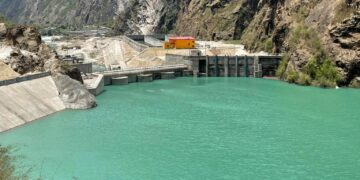
The project involves building 315 kilometers of 400 kV transmission lines, three 400 kV substations, a 40-kilometer segment of the East-West Highway, and maintaining the Narayanghat-Mugling road. Contractors have begun work on the substations and the 18-kilometer Butwal-India border transmission line, with advance payments made by MCA Nepal counted under capital expenditures. The procurement process for the remaining transmission lines and highway segment is ongoing, though the contract for the Narayanghat-Mugling road has yet to be announced.
Despite the suspension, MCA Nepal continues its office operations and is moving forward with procurement procedures. Nevertheless, the low level of expenditure and slow progress have raised serious concerns about whether the project will be completed on time. As per the MCC agreement, all work must be completed within five years of the project’s official start date, which was August 30, 2023. This means the entire project must be finished by August 2028. Given the slow pace so far and the uncertainty surrounding U.S. support, questions are mounting over the project’s ability to meet this critical deadline.