
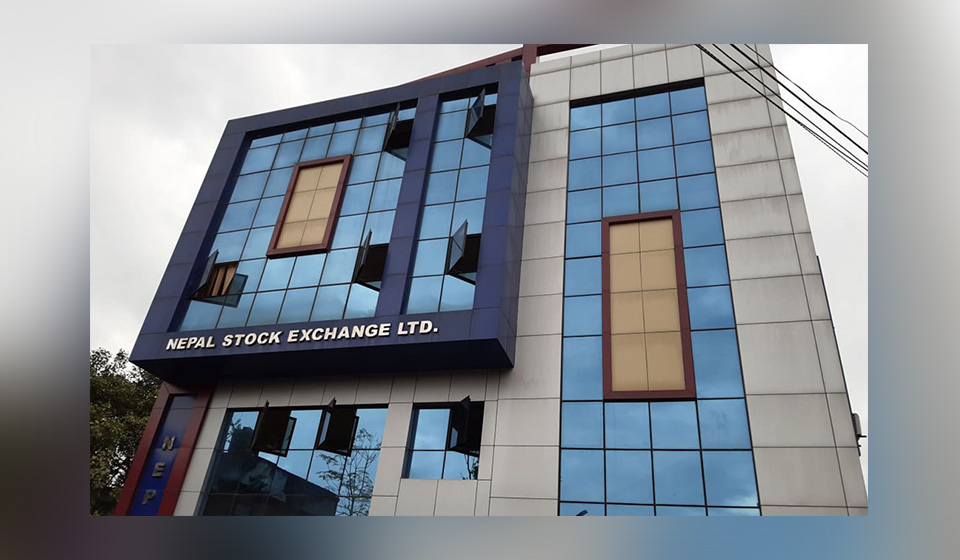
Nepal’s stock market continued its downward trend last week, with the Nepal Stock Exchange (NEPSE) Index declining by 52.62 points, or 1.98 percent, reflecting persistent weak investor confidence and cautious market sentiment.

The benchmark index opened the week at 2,653.40 points and closed at 2,600.78 points. During the five trading sessions, the market touched a weekly high of 2,661.46 points and slipped to a low of 2,592.67 points, recording a volatility range of 68.79 points.
The market declined on four of the five trading days, with only Tuesday posting a positive performance when the index gained 24.57 points. The remaining sessions ended in losses, highlighting sustained selling pressure across the secondary market.
Broad-Based Decline Across All Sectors
All 13 sectoral indices ended the week in negative territory, indicating broad-based weakness across the market.
The Mutual Fund Index posted the smallest decline, falling 0.79 percent, while the Finance Index suffered the steepest loss, dropping 3 percent during the week.
Mixed Performance Among Individual Stocks
Despite the overall market decline, several individual stocks recorded notable movements.
Kalanga Hydro Limited emerged as the week’s best-performing stock, with its share price surging 30.57 percent. In contrast, Three Star Hydropower Limited recorded the largest decline, with its share price plunging 25.60 percent.
Trading Activity Improves
Although share prices weakened, market participation showed signs of improvement.
Average daily turnover increased by 32.40 percent, rising to Rs 4.851 billion from Rs 3.66 billion recorded in the previous week. The higher trading volume suggests investors remained active despite the bearish sentiment.
Market Capitalization Drops by Rs 91 Billion
The prolonged decline in share prices significantly eroded investors’ wealth.
The total market capitalization of listed companies fell from Rs 4.559 trillion to Rs 4.468 trillion, reducing investors’ book value by approximately Rs 91 billion during the week.
The decline came just a week after investors had gained around Rs 25 billion in market capitalization following a temporary market recovery.
Investor Sentiment Remains Fragile
Market analysts say investor confidence continues to remain subdued amid concerns over slowing economic activity, weak corporate earnings expectations, regulatory uncertainty, and cautious institutional participation. While trading volumes have improved, the continued decline in the benchmark index suggests investors are still reluctant to make aggressive buying decisions.
Analysts believe that clearer economic policies, stronger corporate performance, and improved confidence in the financial sector will be essential for reversing the current bearish trend and supporting a sustainable recovery in Nepal’s capital market.